Truett Cathy, the founder of Chick-fil-A, once said something that’s been sitting with me for months:
“The person you will be in five years is the total of the people you spend time with and the books you read.”
Two questions are hiding inside that quote. First, what does the next five years look like if we don’t read at all? And second, the quote isn’t just about individuals. It’s about families. It’s about schools. It’s about all of us, together, raising this next generation of Eagles.
I shared this thought recently with a room full of leaders at a summit in downtown St. Petersburg. About an hour into the talk, I asked the room a simple question: What’s on your mind right now?
A young man in the front row didn’t raise his hand. He just blurted it out.
“I gotta read more!”
The room erupted; half exasperation, half confession, all truth. And underneath the laughter was something every one of us recognized: He was right. So are we, every time we admit the same thing about ourselves.
What We Read Becomes Who We Raise
Here’s something I believe deeply about our IRCS community:
What you and I are reading right now is quietly becoming the future of the children we’re raising together.
I believe that in two ways.
First, it’s true in the obvious sense. If a parent is reading about raising resilient kids, or a teacher is reading about how students actually learn, those ideas start showing up at the dinner table, in the classroom, in the questions we ask our kids on the drive home. What fills our minds becomes the conversation in our homes and on our campus, whether we plan it that way or not.
Second, and this one took me longer to notice, reading reshapes the way we think, even when we never quote a single line out loud. I read Quiet Ambition by Ryan Tinetti back in December. One idea lodged itself in me: ambition is healthy when it’s aimed at benefiting others, not just advancing yourself. I haven’t preached a sermon on that book or assigned it to anyone. But I think about that idea constantly now, and the people I love and lead will feel the effects of it — even if they never know where it came from.
That’s the quiet power of reading. It shapes the parent at the breakfast table, the teacher at the whiteboard, the pastor in the pulpit — long before it ever shapes a conversation.
We Can All Read. We’re Just Not.
Here’s the strange paradox of our moment: nearly everyone in our community can read. Functional illiteracy has been all but eliminated in our part of the world.
And yet we have a reading crisis on our hands, not because we lack the skill, but because we’ve stopped using it. We scroll constantly. We absorb bite-sized fragments at an alarming rate. But the kind of reading that digs into the heart and mind, researched, considered, the kind that Aristotle believed prompted real action, has quietly fallen out of our daily rhythm.
Mark Twain saw a version of this coming over a century ago:
“The man who does not read has no advantage over the man who cannot read.”
Alvin Toffler updated it for our age:
“The illiterate of the 21st century are not those who can’t read and write; it is those who won’t.”
We live in remarkably innovative times, but many of our deepest challenges as parents, teachers, and a school community won’t be solved by something new; they’ll be solved by remembering something old. And one of the things worth remembering is simply this: reading matters, and it’s worth fighting for, in our homes and on our campus alike.
Why Reading Out Loud Still Stops a Room
I’m not anti-technology. It’s a genuine gift, and I’m grateful for the ways it serves our school and our families. But it has changed how we experience wonder. A phone can show any of us the highlight reel of someone else’s life at any moment, and over time, that constant stream dulls our sense of amazement. Very few things make us pause anymore.
Except one. Reading out loud slows people down.
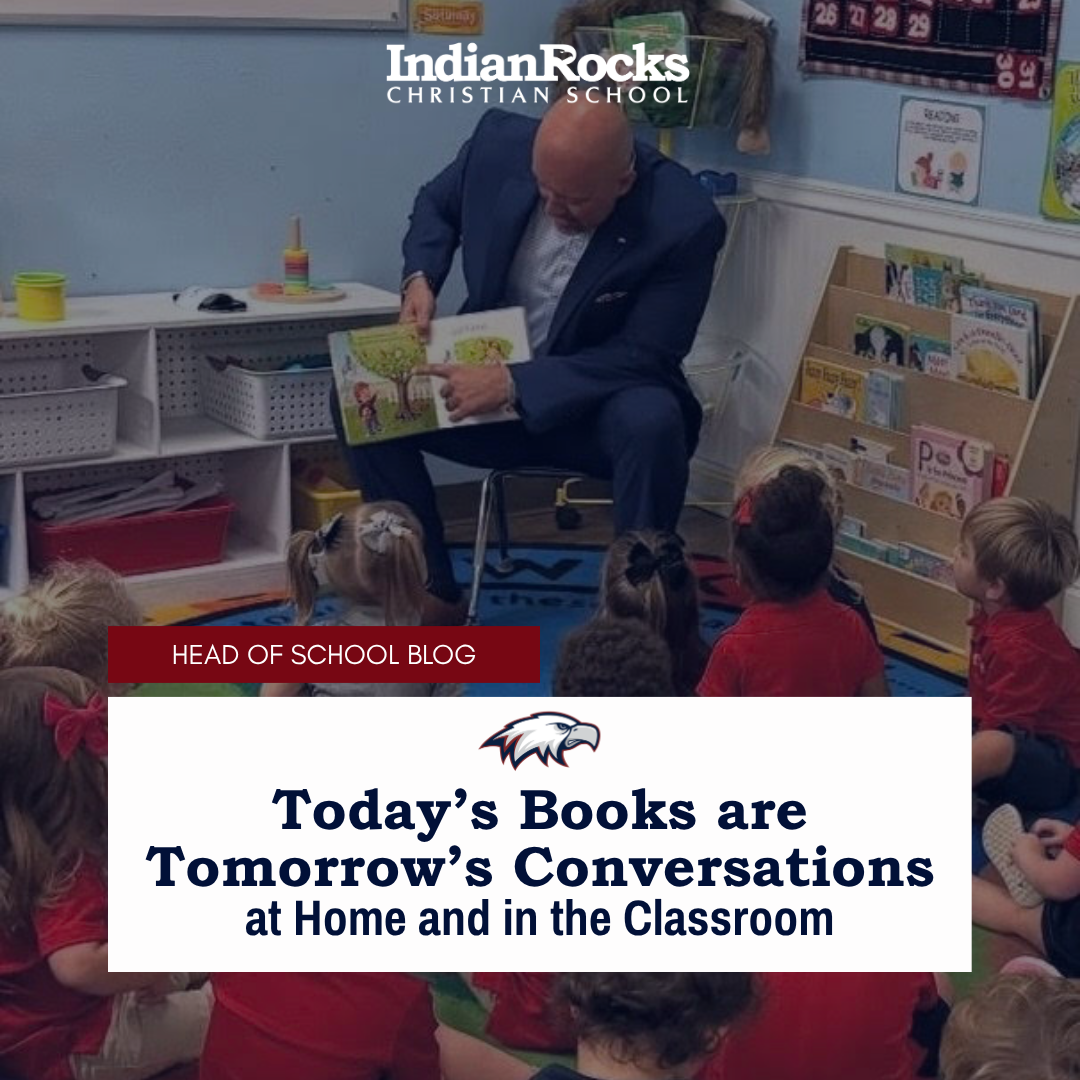
I’ve watched it happen in a room of our youngest two- and three-year-old students. I’ve felt it while listening to Pastor Asa read a long passage of Scripture. I’ve seen it around a table when I’ve asked someone on our team to read aloud from a book we’re studying together.
Every single time, the same thing happens: people stop. They listen. The room gets quiet.
There’s something in us that still recognizes reading aloud as a sacred act — words carrying weight, time being given as a gift. So here’s my encouragement to every parent and teacher in our IRCS family: keep reading, and read out loud to the children in your life when you get the chance. It may be one of the simplest gifts you give them this year.
The Numbers Should Bother Us a Little
President George W. Bush once entered a year-long reading competition against one of his own senior staffers while leading the free world; he read 95 books in a year.
And he still lost.
Jim Rohn put it plainly: “Reading is essential for those who seek to rise above the ordinary.” This isn’t just a habit for heads of state. It’s a habit for any of us who want to raise our children, teach our students, and shepherd our community well.
I think reading matters more now precisely because fewer people are doing it. Less than half of American adults finished even one book last year, and the numbers are worse for men specifically. That trend line has been heading in the wrong direction for a decade.
But here’s the encouraging part: the research on reading’s benefits hasn’t budged. A consistent reading habit is tied to lower anxiety, longer life expectancy, higher income potential, and greater career advancement. Reading doesn’t just deliver information — it builds the muscles of thought itself. The mind responds to reading the way the body responds to exercise: it gets stronger because it’s been worked.
And the earlier this starts, the deeper it goes. This is part of why I care so much about reading at IRCS, because kids who read regularly build larger vocabularies, perform better academically, and grow in emotional intelligence. It’s not an exaggeration to call it a game-changer in a child’s development, and it speaks directly to the sound mind we hope every Eagle leaves us with.
Five Ways to Build a Reading Culture at Home
If you’re a parent partnering with us in your child’s education, which is exactly how we see this relationship, a few things have worked for our family and for the IRCS families I’ve watched do this well:
- Model it. My dad was a busy school administrator and coach, but he always made time to read. I never forgot that.
- Read to them. I still read ‘Twas the Night Before Christmas to my kids every Christmas Eve. They’re 24, 22, and 20. Strong readers are forged in the laps of their parents; start young, and don’t stop just because they’ve gotten tall.
- Give books as gifts. What we give tells kids what we value. Make books a regular part of gift-giving, and ask them to give you one too.
- Try e-books. Since the pandemic, I’ve read over 300 books, most of them on a tablet or phone. Having every book with me at all times has given me a better option than scrolling, and our kids are already digital natives. Use that.
- Reward reading. Trade screen time for book time, offer a small reward for finishing a book, or take them to the movie adaptation after they’ve read the book first.
On Re-Reading
I used to have zero interest in re-reading a book. Once was enough; onward to the next one. Then I came across a line that froze me in my tracks:
Re-read old books; they have stayed the same, but you have changed.
That’s the whole case for re-reading in eight words. The book hasn’t moved. You have. And what it has to say to you now might be entirely different than what it said five years ago, which is true of Scripture above all.
My Top 10 Reads This School Year
These are the ten books from this year that I’d most want to put in the hands of any parent, teacher, or pastor walking alongside us at IRCS. Each one shaped how I think, lead, or love the people in my life, and I hope a few of them do the same for you.
- Joyful Outsiders: Six Ways to Live Like Jesus in a Disorienting Culture — Patrick Miller & Keith Simon
- Raising Gender Confident Kids: Helping Children Embrace Their God-Given Design — Dr. Kathy Koch & Dr. Jeff Myers
- The Claypot Conspiracy: God’s Plan to Use Weakness in Leaders — Dave Harvey
- Scrolling Ourselves to Death: Reclaiming Life in a Digital Age — Brett McCracken
- Them: Why We Hate Each Other and How to Heal — Ben Sasse
- Below the Waterline: Shoring Up the Foundations of Leadership — Gordon MacDonald
- The Desecration of Man: How the Rejection of God Degrades Our Humanity — Carl Trueman
- Gradually Then Suddenly: How to Dream Bigger, Decide Better, and Leave a Lasting Legacy — Mark Batterson
- Becoming Like Jesus: The Everyday Journey to Living a Life of Holiness — Matt Chandler
- 2084: Artificial Intelligence and the Future of Humanity — John Lennox
My Complete 2025–2026 Reading List
For the completionists among you, here’s everything I read this school year, month by month.
August
- Radically Whole — David Gibson
- Leadershift — John Maxwell
- Leadership in a Chaotic World — Southern Baptist Theological Seminary
- Joyful Outsiders — Patrick Miller & Keith Simon
- A Matter of Conscience — Abraham Lincoln
- Waiting Isn’t a Waste — Mark Vroegop
- 11/22/63 — Stephen King
- Numbers, Leviticus — Bible
- Beyond Personality — C.S. Lewis
September
- Take Every Thought Captive — Kyle Idleman
- Crucial Conversations — Patterson & Grenny
- A Hobbit, A Wardrobe, and a Great War — Joseph Loconte
- Joshua, Judges — Bible
- Art and the Bible — Francis Schaeffer
- With All Your Heart — Craig Troxel
- Necessary Endings — Henry Cloud
October
- The Lord of Psalm 23 — David Gibson
- Culture Making — Andy Crouch
- Rethinking Strategic Planning — Alan Pue
- Slow Productivity — Cal Newport
- I, II Kings — Bible
November
- Integrity — Henry Cloud
- Raising Gender Confident Kids — Kathy Koch & Jeff Myers
- The Christian Manifesto — Alistair Begg
- I, II Chronicles, Ezra, Nehemiah — Bible
- Tame Your Thoughts — Max Lucado
- Rethinking Sustainability — Dr. Allan Pue
December
- The Claypot Conspiracy — Dave Harvey
- An Angel’s Story — Max Lucado
- Weakness Is the Way — J.I. Packer
- How Leadership Actually Works — Larry Yatch
- Let Earth Receive Her King — Alistair Begg
- Job — Bible
- Quiet Ambition — Ryan Tinetti
January
- Anchored — Scott Davis
- Scrolling Ourselves to Death — Brett McCracken
- On Grand Strategy — John Lewis Gaddis
- The Nehemiah Code — O.S. Hawkins
February
- Learning from the Best — Gene Frost
- Lead with Prayer — Skoog and Greer
- The God Who Is There — Francis Schaeffer
- Them — Ben Sasse
March
- How Leaders Lose Their Way — Peter Greer
- Reading and Studying History in a Biblical Worldview — Roger Erdvig
- Leadership as Identity — Crawford Loritts
- Extraordinary Influence — Tim Irwin
April
- Below the Waterline — Gordon MacDonald
- The Desecration of Man — Carl Trueman
- Gradually, Then Suddenly — Mark Batterson
- Doing Life with Your Adult Children — Jim Burns
May
- Truth Changes Everything — Dr. Jeff Myers
- The Power of Regret — Daniel Pink
- Finish Empty — Jason Curry
- Becoming Like Jesus — Matt Chandler
June
- Rethink Yourself — Trevin Wax
- The Demon of Unrest — Erik Larson
- 2084 — John Lennox
So here’s my encouragement to you — parent, teacher, pastor, friend, fellow members of this IRCS family trying to be faithful with what’s been entrusted to you: keep reading. Make time for it. Read to the people you love, and read out loud to the children we’re raising together.
Because at IRCS, we’re not just teaching kids to read—we’re shaping sound minds, servants’ hearts, and skilled hands for whatever God calls them to in this life. And it starts, in no small part, with the books open on our own nightstands tonight.
Read on, Eagles.
Dr. Hobbs