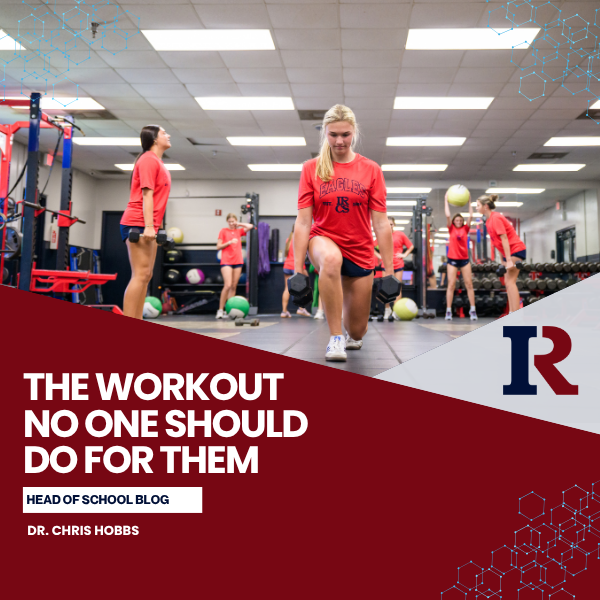
The Impact of Authentic Work on Students in an Artificial Age
Artificial Workouts?
For the past few months, I have paid a personal trainer to work out for me. Three mornings a week, he shows up at the gym, loads the bar, and knocks out a beautiful set of squats. I sit on the bench with a protein shake and cheer him on. His form is flawless. He has never missed a session.
I am not any stronger.
I have thought about asking for a refund. I have thought about finding a better trainer. It has not yet occurred to me that the arrangement itself is the problem.
(Spoiler alert: This never actually happened. But it makes the point below.)
No one would pay for that deal. Yet our students are offered it every day. A program writes the essay. An app solves the equation. A summary replaces the chapter.
The work gets done, and the child stays the same.
Anyone who has spent time under a barbell knows the rule: you have to move your own weight to get your own result. Carey Nieuwhof says it another way in AI and the Future Church: “Whatever is outsourced to AI atrophies.” That holds true for muscles. It holds true for minds.
Information & Formation
I recently enjoyed a lively debate with a successful executive. They advocated accelerating the adoption of artificial intelligence across all areas of life. I urged caution about its formative impact on students. The conversation left me with plenty to think about. (I picked up a few new AI tricks, too!)
So how do we balance the rapid gathering, organizing, and synthesizing of information with our responsibility for the healthy formation of our students? As Andy Stanley would say, “It is not a problem to be solved; it is a tension to be managed.”
What Work Is For
Before we decide what technology should do for our children, we need to know what work is for. Scripture paints a clear picture in three words: dominion, drudgery, and demand.
Dominion. God gave us work before sin entered the world. In Genesis 1, He blesses the first man and woman and tells them to fill and subdue the earth. In Genesis 2, He places Adam in the garden “to work it and keep it.” Work is part of bearing God’s image. We take what He made and help it reach its full potential. Tools belong in that work, too. In Exodus 31, God fills Bezalel with skill to craft with gold, stone, and wood. The skill comes first. The tool multiplies it.
Drudgery. Then sin entered, and work changed. Genesis 3 describes thorns, thistles, and the sweat of the brow. Drudgery is the broken part of work: the tedious, the repetitive, the wasted motion. Technology does real good here. A dishwasher removes thorns. So does a spreadsheet. Relieving drudgery is good stewardship.
Demand. Hard work was part of God’s design before the fall, and it remains a gift after it. Demand is the effort that stretches us, and it works both ways. The harder we work to bring something to its full potential, the more that work brings us to ours. We pour into the work, and the work forms us. Hebrews 12:11 tells us discipline “seems painful rather than pleasant, but later it yields the peaceful fruit of righteousness to those who have been trained by it.” The training is the point. Paul Matthews, an expert on AI in Christian schools, would say it this way: “The friction in the learning experience isn’t a bug in the system; it’s the feature.”
Let technology help us take dominion. Let it reduce drudgery. Never let it erase demand.
At the Kitchen Table
What does this look like at home?
- Spell-check on a finished essay reduces drudgery. A tool that writes the first draft erases demand.
- A calculator on a complex physics problem reduces drudgery. A calculator before a child knows the math facts erases demand.
- An app that organizes the week’s assignments reduces drudgery. A summary that replaces reading the chapter erases demand.
The authors of The AI Apocalypse ask a question I keep returning to: “Is the work this tool is doing for me replacing something that should be done to me?” Ask it about your child’s homework. For younger children, keep the question simple:
Is this removing the thorns, or removing the workout?
Inside IRCS
Our faculty and staff are wrestling with the same questions. This fall, they sorted real tasks from a teacher’s week into three groups: drudgery, demand, and the work that must stay in our own hands. They hold to a simple standard: think before you prompt, and always touch it last. Our teachers carry that same discipline into the classroom, where students learn to check what a tool tells them.
Confident is not the same as correct.
This is how we form sound minds, servants’ hearts, and skilled hands. And skilled hands are never built by watching someone else lift.
This Week
Find one place where technology is doing your child’s workout, and hand the weight back. Then find one place where it lifts real drudgery, and thank God for the gift. You don’t need to throw out the devices. You just need to put them in their proper place.
“Whatever you do, work heartily, as for the Lord and not for men.” (Colossians 3:23)
God bless & Go Eagles!